
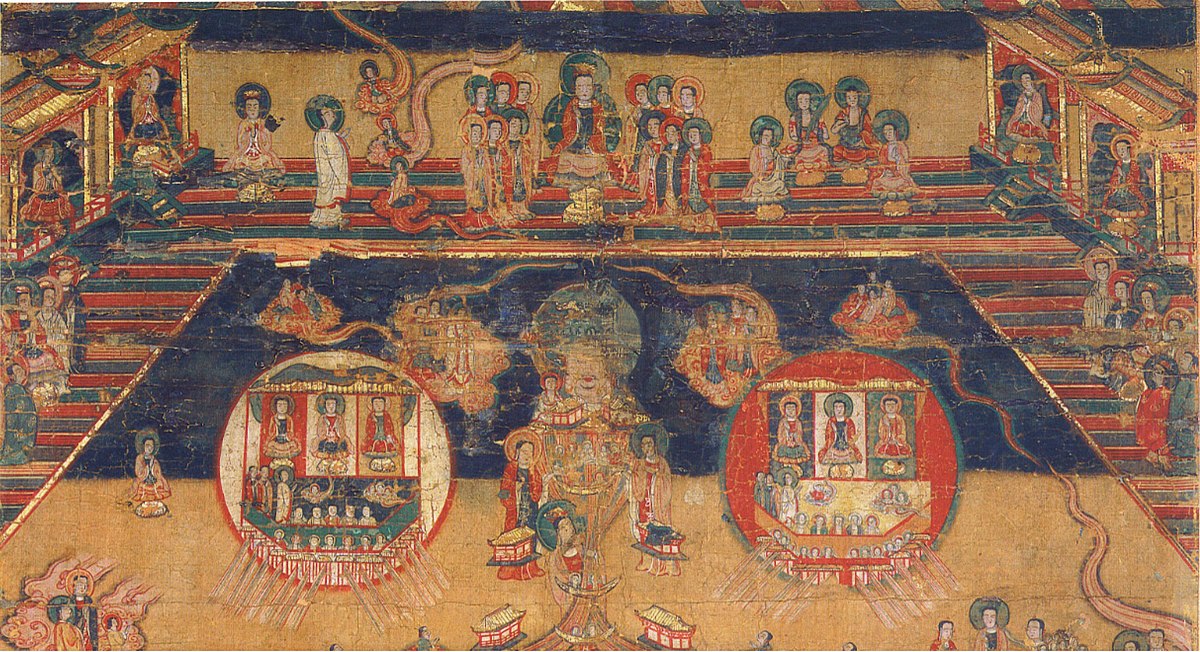
Manichaeism was a world-religion established in the 3rd century Sassanid Persia by the prophet Mani (216–274). Despite its complex cosmology, the religion sought to combine teachings from a variety of faiths across Eurasia, allowing it to shapeshift according to local cultures and religions. This article provides a short introduction to the spread and transformation of Manichean faith in China, where it ultimately integrated into Maitreya Buddhism.
It is no mystery that the great distances connecting Europe and Asia were overcome more than centuries ago, whether in trade, ideas or faith. While Islam may be a strongest example of a spiritual blanket resting at the edges Eastern Europe and reaching all the way to South East Asia, it is not the first – a divine innovation of Persian kind was perhaps first to achieve the status of a world religion. This faith called as Manichaeism was a world religion originating from Parthian Persia in the 3th century. The Manichaean teachings, based on the teachings of the prophet Mani (216 – 274/277), brought together facets of different belief systems and teachings such as Zoroastrianism, Christianity and Buddhism, as well as elements from gnostic and other ancient cults. The religion extended far and wide, traveling onward from its Persian homelands to the Roman Empire in the West, and through Central Asia to China. At the core of Manichaean belief is the struggle between light and darkness, in which Mani is naturally the prophet of light.
The story of Manichaeism is naturally interesting for being an early world religion spanning across vast spaces and influencing a variety of cultures of Eurasia. However, it is this distance, with its syncretic tapestry of beliefs, that makes Manichean past both fascinatingly complicated and complicatedly dispersed. It came under suppression in both ends of its realm, in Rome and in Tang China, and ultimately it may have become something else entirely.
I. Mani at the Centre
The Manichean faith was born in Parthian Persia. Mani, its prophet, promoted a relatively complicated cosmological view at the core of which was the struggle between the Realm of Light and the one of Darkness. These two were separate in the beginning of time, but became entangled, though ultimately the Light and life will be victorious over Darkness and death. The system is evidently dualistic, but not of equals. It is also arguably partly gnostic with Mani’s personal divine revelations, although not as dedicated to some hidden knowledge, as Mani’s explicit mission was to share what was happening beyond the veil.
Manichean universalism was not a byproduct of its theological structure, but rather intentionally designed to reach out far from its original homelands. An edition by Lain Gardener and Samuel Lieu ponders that “Manichaeism is the first real ‘religion’ in the modern sense, because Mani established it directly and deliberately, with its scriptures and its rituals and its organisation all in place.”1 According to them, an important part of his mission was specifically the creation of a universal community, a project which kept him busy in his travels and proselytizing efforts.
It is said that Mani’s father had heard a voice telling him to avoid eating meat, drinking wine and not to mingle with women. Mani’s father became a baptist himself, later taking his son to join them as well. Mani, however, had a complicated relationship with baptism. Supposedly at the age of twelve and twenty-four he had met his “divine twin,” who had convinced him of his prophetic quality, but who nevertheless insisted on him staying with his sect – though his stay was not entirely harmonious. In fact, Mani rejected the notion of baptism, along with the notion of ablution, a cleansing wash, seeing such practices harmful to “light particles.” Mani also rejected or altered many other cultural conventions, whether it was the type of bread used in rituals, or radically reinterpreting ‘rest of hands’ to reject physical work. Naturally he ended up leaving the sect not entirely on great terms.
Seeing prophetic qualities in himself, he set out as a missionary. The events unfolding in these travels seemed to affirm his beliefs in his holy mission. In Persia he met a “hairy hermit” who told him that his unusual look was due to “taking the best fruits from a tree, thus confirming Manichaean belief in the need of the elect members to avoid hurting the Light elements which are in fruit and vegetables.”2 The Light is an important, arguably a core element of his cosmological view, one which was retained even after the faith’s eventual integration with Buddhism in the East. Regardless if this obsession with Light was due to the Zoroastrian influence, whose deities Mani’s cosmology had also integrated early on, Zoroastrianism was either way the religion of his patrons who were important for his venture.
Mani was more than aware of the syncretic nature of the religion he founded, considering “himself to be the perfection and fulfilment of the three great religions, Buddhism, Zoroastrianism and Christianity.”3 Buddhism, which was naturally picked up in the regions east of his homeland, added to the universal qualities of his faith, while Christian iteration of Manichaeism spread in the Roman Empire. This universalism was beneficial for Mani’s spiritual reputation in Persia, allowing him to become part of the king’s retinue and giving him access to missionary work in and around the empire. Mani’s fusion of religions, its adaptive power and the patronage it received made his religion act as both geographically central in its Persian origins and local to the religious landscape of Inner-Asia.
Of course, it was not Mani alone who would spread his message as this project was also driven by his disciplines. One of his contemporary followers – or apostles, Mar Ammo, was tasked to carry on missionary activities in Eastern Central Asia, specifically in Sogdiana.4 The Sogdian language would later become a major Manichean language in its Eastern part of the Church. The expanding domain of the faith would naturally affect the liturgical languages.

– Wikimedia – Turpan Antiquarian Bureau (Turpan, China), 81 TB 65:01.
Early Manichean scripts were written in an alternative Syriac script later name as the “Manichaean script” by the German linguist Friedrich W. K. Müller (1863 – 1930 – not to be confused with a few decades preceding philologist Friedrich Max Müller). The languages of the scripture were understandably Iranian languages, such as Parthian (to which Manichean texts have been a great source), Middle Persian and the aforementioned Sogdian.
The syncretic hook of Manichaeism did not mean that all the myriad of influences were present in all iterations of Mani’s faith at all times, rather it integrated into the local cultural systems and practices. However, it was in Central Asia where many facets of Manichaeism, such as Christianity, Zoroastrianism and Buddhism, ultimately blended together.
II. Mani in the East
It is not exactly clear when the faith of Mani arrived in China, where it was initially called Móníjiào (摩尼教), but it certainly did arrive from the Central Asian direction. The Fujian Gazetteer (Minshu 閩書, 1620) states it arrived during the Tang Dynasty (618 – 907), though in the light of contemporary research it likely had appeared in China even before Tang. Although the religion did not enjoy a warm welcome in Tang China, it seemingly gathered enough adherents to reach its peak popularity in the following Song Dynasty, after which it fell in jeopardy again in the Ming dynasty a few hundred years later. Manichaeism was mostly practiced by people of Central Asian origins, as in “Western barbarians” such as Uyghurs, and was thus able to enjoy a certain level of tolerance in the past.
Therefore to trace the Manichean trails to China, we first have to take a look at one particular place in-between northern Central Asia and China, that is the realm of the Uyghurs. The Uyghur Khaganate (being one of the Toquz Oghuz in Old Uyghur- “Nine clans”) was a confederation of clans ruled by the Uyghur nobility, also to be known as the Uyghur Empire after 744. Külüg Bilgä Khan was the first ruler to convert to Manichaeism in 760 and to establish this as a state religion. The reason for the conversion is unclear, but Johan Elverskog sees trade as potentially one of the strongest reasons.5 As mentioned previously, Sogdian was one of the languages of the discovered Manichean scriptures, as Sogdians were themselves Manichean – but the origin of this link was perhaps their centuries lasting management of the Silk Road’s central trade. The Uyghur Khan may have considered the conversion to Manichaeism to be of benefit for trade relations.
After the death of the tenth khan, Zhaoli Qaghan, the khaganate struggled with instabilities until it was ultimately destroyed by the Kyrgyz in 840. Two groups of Uyghurs fled the crumbling realm, both to Tang, only one of which making it into the Chinese domain.

This second group, led by Wujie Qaghan, demanded a local hold as a base from which to rebuild the khaganate, a demand the Tang leadership refused. Though the chancellor Li Deyu initially gave them some necessities, such as food and clothing, the tense politics of the situation soon escalated. Uyghurs attacked their claimed city, and in 843, Tang’s troops staged a counter attack resulting in a massacre and mass capture of the Uyghurs. What is notable here is the religious persecution that followed – Manichaean temples were closed, Manichaean books and images were burned, apparently nuns were killed, and the clergy were disbanded. According to one prominent scholar of Manichaeism, Peter Bryder, the religion as such never recovered from this devastating setback that appeared to have extinguished the light of Mani in China.6 According to him, what remained was to be Sinicized in the absence of contact to the West, though the extent of this project is up for a debate.

“Conversion of Bögü Qaghan (759-780 CE) to Manicheism in 762 CE” – Wikimedia
Many practices of Manichean devotees, some of which Mani himself had learnt early in his life from his father, were considered suspicious in China. In the Song-era Fozu tongji, a grand account on Buddhist history (“Annals of the Patriarchs of Buddhism”) by Zhipan (志磐), we may find a few mentions of these. This massive 13th century work describes Manichean habits as follows:
“The practice of this sect is to abstain from meat and alcohol, and the followers sleep through the day and come out at night, holding incense as the token and secretly mingling with other persons and calling themselves ‘virtuous friends.’”
It also describes them as “vegetable eating, demon worshiping.” These rather opinionated commentaries on practitioners of Manichaeism are quite common in the sources of all kinds and pose a reoccurring challenge for the historiography in both East and West.
However, due to the scarcity of primary sources one must follow a trail secondary accounts if they are inclined to create a holistic picture of Mani’s faith. Being a syncretic religion, or at least a religion prone to syncretism, its story is certainly incomplete without discussing what it merged with. We are, after all, talking about centuries of religious and social development. In this part of the world, Mani became identified as the “Buddha of Light” – some indication of this can be found in the Fujian Gazetteer that also calls him “Mani the Buddha.” Perhaps the most prominent companion to Mani’s beliefs was Maitreyan Buddhism. In broader and vaguer terms, Manichean strains of Buddhism were to be considered part of “White Lotus Societies,” mainly of Pure Land Buddhist salvational traditions.

Maitreyan Buddhists believe that Maitreya, a prophesied future buddha, will arrive and bring forth an environment more suitable for enlightenment. This renowned buddha with almost a royal gleam (sometimes also expected to take the ruler of the Buddhist spiritual kingdom of Shambhala) will appear in the era of declining Dharma to help people back on the virtuous path. The prophecy of Maitreya and the eschatological nature of this belief made the adoption of Maitreya into Manichean framework, in which the utmost important tasks of men is to restore light into the world, surprisingly uncomplicated. It is also good to note that Maitreya’s history as a figure of salvation in China goes back to the 5th century Southern and Northern Dynasties, where the buddha was integral part of the Pure Land doctrine. It would then make sense that these facets had mingled with Manichean beliefs relatively early on.
It is worth mentioning here that Buddhism, which came to China around the first century, was faced with opposition from the very beginning. First Daoists thought of it, according to Bryder, merely “Buddhism with a foreign name.” A few hundred years later Buddhists and Daoists were engulfed in scholarly skirmish. Buddhism became popular in Tang, while facing prosecution not so much from the emperors, but particularly from individuals of other faiths. In Bryder’s view, it makes sense to consider that “these circumstances could have been the starting point for potential Manichaean congregations, especially after the persecution in 843.” After the assault on Manichaeism in the mid 9th century, exercising the faith in this new context in which Buddhism had ascended to a great popularity, was probably a reasonable adaptation strategy.
Maitreyan Buddhism had thus merged with Manichean faith probably already in Southern and Northern dynasties (420 – 589), while becoming increasingly entangled already in the Tang dynasty, both faiths nonetheless ending up prohibited during this era. This merging is indicated by a few religious details, such a certain Manichean dialogue between a messenger and a god: “When the Buddha entered Nirvana, he demanded: ‘you shall be right here waiting for Maitreya”.7 In some early Chinese translations of Maitreyan scriptures, Maitreya is apparently even pictured as a Manichean deity, while another source indicates that Manicheans used Buddhist terminology at least as early as in the 8th century.8 The synchronism thus happened early, possibly already within some merging in the shared homelands of Central Asia.
Manichaeism’s fate after Tang Dynasty’s ban in 843 is somewhat complicated, though its residues are particularly traceable in Buddhist sects. In an attempt to track down its history we may again note some fusion features indicating an entanglement of Manichaeism and Maitreyan Buddhism. The use of incense in different rituals was one of the iconic practices of the Manicheans at least from the Tang dynasty onward. This practice began to receive even larger, perhaps more identitarian meanings, in the later Red Turban Rebellions against the Mongol-led Yuan Dynasty, in which incense burning and gatherings, as well as the worship of Maitreya Buddha, became an important part of the rebels’ bond and identity. The rebels even took the name of “Incense Army.”9
Manicheans probably did not disappear after Yuan, or at least the trail of Manichaeism did not. Apparently, what is presumed to be a continuation of Manichaeism ended up in trouble over their variant Chinese name – Mingjiao (明教 “Religion of Light”) – during the Ming dynasty, as the name violated a naming taboo over the dynastic character Ming 明. The original renaming from Monijao 摩尼教 to Mingjiao 明教 has been attributed to a Manichean missionary Hulu.10 The punishment that followed this violation was supposedly a drastic blow to Manichaeism’s survival in South China. Whether the Religion of Light was Manichaeism as such is one question, while the Manichean legacy particularly after the Ming dynasty is a bit of a puzzle as a whole. According to the previously mentioned Fujian Gazetteer, written in the era of Qing Dynasty, there were seemingly only few Manicheans left.
Yet this period is not without its artifacts. One of the great findings in the so called Xiapu manuscripts was a manual of rituals of the Religion of Light, named Mani the Buddha of Light. The collection is dated somewhere between late-14th to early-15th c. In its chant for inviting the Buddhas of the Five Directions, the deities summoned are in fact Manichean angels.11

The combination of Manichean mythos and Buddhist terminology in the manuscripts of the Religion of Light seems to imply some kind of proof of continuum from Tang-era Manichaeism into Ming-era Religion of Light, even if it was heavily Sinicized. To what extent we are able to discuss them as the same religion and to which degree would Manichaeism in its ancient, Central Asian form even be recognizable to a follower of the Religion of Light – or any other Buddhist variation including Mani – is one of the core questions of this investigation. This ambiguous legacy of the prophet of Light is discussed below.
III. Mani at the end of the Earth
Considering that Manichaeism was seemingly driven underground by the more powerful forces of the period, a lot of questions of its organization and the extent of its reach remain. The sources are scarce, and many from the contemporaries of Manichean followers are quite negative and not particularly informative, giving a way for speculative pondering regarding the actual beliefs in the Manichean faith in East Asia. As we have noted earlier, Manichaeism was a syncretic and fluid belief system by design, and its march across vast geographies and crossing of myriad of cultures meant that what was to become of it would be necessarily something rather different from its Persian origins. To trace its residues in all these sources is not a simple task. The followers of Mani who were translating their sacred texts into foreign languages used terminology of local religions in order to ensure clarity and avoid alienation.12 And yet, we may have to ask, to what extent was what came out of the post-9th century devastation Manichean at all? Was Mingjiao Manichaeism?
In some cases traces of Manichaeism may be easier to spot in material reality than in the depths of translation and scripture. One of the few, or perhaps the only remaining Manichean building is the Cao’an (草庵) temple in Sunei village in Fujian. This temple still hosts a Yuan-era statue of Mani the Buddha of Light (摩尼光佛). In an interesting fieldwork by Yanbin Wang, it is attested that the locals’ attitude towards Manichaeism is “both passionate and indifferent.” The villages had little understanding of the faith and felt even defiant towards the government’s attempt at “enhancing the Manichaean characteristics” of the temple. However, at the same time the villagers do, according to the observing researcher, worship Mani the Buddha of Light and Mani the Lord (摩尼公) at the temple. These Manichaean traits are integrated into the local Buddhist traditions. Apparently the villagers even collect and disseminate local stories regarding Manichaenism.13

There are a variety of stories collected in Sunei regarding their Manichean ancestors. According to Wang, the sources for these tales stem from “(1) Clan genealogies; (2) Interpretations of Mingjiao in the context of peasant war history research; (3) Contemporary Manichaeism research and related materials; (4) Local customs and traditions.”14 In some sense, the main interest lies in the locality itself rather than in exploration of religious beliefs. Wang notices that some of the tales have been reinforced with new materials in recent years, and considers one story explaining the origins of the Mani the Buddha statue to have developed from a part in Minshu. These stories are clearly living and evolving as time goes on, implying certain level of engagement with the people who are, again, passionate and indifferent to Mani’s religion.
What is quite curious regarding Manichean travels themselves, is that at least two of the stories hint toward an unlikely expansion of Manichean spread in the region. According to one, most Manicheans in the region followed the Ming general Koxinga (hok. Tēⁿ Sêng-kong 鄭成功) to Taiwan to reclaim the island from the Dutch colonizers. However, they would be subjected to “multiple rounds of purges and looting by the Qing government and faced strict prohibition.” In another, the villagers joined Koxinga’s forces to fight the armies of the (Manchu-lead) Qing “until they crossed the sea to reclaim Taiwan.” 15 Certainly these stories stem from some past in which people traveled from Fujian to Taiwan, but whether there were Manicheans or merely ancestors of any other faith, is of course difficult to say.
Considering these perplexing layers of beliefs, the historical suppression, and its eventual integration into folk and Buddhist beliefs, what can we say about the reach of Manichaeism in the region? One interesting, though unlikely, speculation concerns a possible legacy temple in Taiwan. An ambiguous passage in now seemingly inaccessible article “Manichaeism and its Spread into China” (2002) by Jennifer Marie Dan states that:
“In an e-mail posted to a Gnostic Society, Peter Bryder of Lund University in Sweden reports that he has inside information about the continued existence of the “Religion of Light” as a secret society and even more information about the existence of some Manichean temples in Taiwan.”16
Interestingly enough, I personally received a similar hearsay from a professor who had lectured in Taiwan around two years ago, who himself had heard of such a temple in southern Taiwan. Regardless what these rumours refer to in reality, they seem to point to the southern part of the country in the proximity of Koxinga’s landing. Of course, unless these mysterious temples were of some modern iteration of Mani’s faith, such temples would most likely have not been recognized as Manichean by either its frequenters or outsiders. Rather, they could have been temples of some other variety of White Lotus Society, and the idea of a Manichean legacy would unlikely be as clear (if still as perplexing) as Sunei villagers’ understanding of Cao’an.

Clearly there is a folk belief in both sides of the strait that tells of Manichean movement towards Taiwan, even if such tales may be merely reflections of general Early Modern migrations to Tainan. Regardless, when it comes to the question of temples, we have a different kind of a puzzle in our hands. As the case of Sunei village illustrates, one has to make a distinction between the ways in which practitioners identify their beliefs and the historical lineage of such belief systems. As such, when studying these historical traces, one may have to redefine what actually Manichaeism means beyond its ancient church – would ancient Manicheans even recognize those Mingjiao devotees as Manichean to any extent, even if Mani the Buddha was revered within the syncretized belief system? In fact, maybe we should ask if we are really following the historical traces of Manichaeism at all, or merely the centuries trailing path of Mani as a divine figure? For now, these questions seem incredibly difficult to answer.
Epilogue
The syncretic realm of Manichaeism and its extensive Eurasian spread, along with its multilingual and at times scarce sources, make it an interesting subject of study. Chen Yuan, an important scholar of Manichaeism in China among other subjects, lamented that the religion’s “[…] traces are destroyed, it’s history not be seen […] only through anti-Mani Christian records can we still recognize its general outline.”17 Wang also points out something to this extent – that certain clan’s family records in Sunei mention their Manichean ancestors’ resistance towards “dark rulers,” but the genealogies ultimately do not go much into detail because of the suppression faced by the religion.18 This serves as a yet another point to what this article has tried to demonstrate, in that there are in fact plenty of other, though imperfect, sources that can help in investigating Manichean history. It is, however, unfortunately the case that to a certain extent its history has been obscured, at least to the extent it was ever written in the first place.
It is also interesting to ponder, from a more non-academic angle, how one modern-day universalist religion, the Baha’i faith, was also born in Persia, even if much later in the 19th century. The Baha’i faith variably deems Buddhism part of its historical canon, Buddha being a Manifestation of God and, in some interpretations, the founding prophet Baháʼu’lláh is seen as the Maitreya Buddha. There is no direct relation to Manichaeism – maybe there is just something in the Persian soil that gives way to a certain level of divine confidence.
In a way, the rivers of time may have moved Manichean beliefs into different shapes, losing – or at least transforming – the core of Iranistic dualism in the process. In this sense Manichaeism may not have literally traveled till “the ends of the Earth” as claimed in the title, but rather morphed into different faith systems according to its localities as its legacy dribbles down over time. But then again, has this not been the fate of all faiths?
Further reading
- Bryder, Peter. The Chinese Transformation of Manichaeism – A Study of Chinese Manichaean Terminology. Stockholm: Bokförlaget Plus Ultra, 1985.
- Elverskog, Johan. A History of Uyghur Buddhism. New York: Columbia University Press, 2024.
- Gardner, Iain and Samuel Nan-Chiang Lieu. Manichaean Texts from the Roman Empire. Cambridge: Cambridge University Press, 2004.
- Ma, Xisha, and Huiying Meng, eds. Popular Religion and Shamanism. Religious Studies in Contemporary China Collection, vol. 1. Translated by Zhen Chi and Thomas DuBois. Leiden: Brill, 2011.
References
- Iain Gardner and Samuel Nan-Chiang Lieu, Manichaean Texts from the Roman Empire (Cambridge University Press, 2004) 1. ↩︎
- Gardner and Nan-Chiang Lieu, Manichaean Texts from the Roman Empire, 4. ↩︎
- Ibid. 3. ↩︎
- See for example: Samuel N. C. Lieu, Manichaeism in the later Roman Empire and medieval China – A Historical Survey (Manchester University Press, 1985), 64 ↩︎
- Johan Elverskog, A History of Uyghur Buddhism (Columbia University Press, 2024), 9. ↩︎
- Peter Bryder, The Chinese Transformation of Manichaeism – A Study of Chinese Manichaean Terminology (Bokförlaget Plus Ultra, 1985) 9. ↩︎
- Xisha Ma, “The Syncretism Of Maitreyan Belief And Manichaeism In Chinese History” in Popular Religion and Shamanism (Brill, 2011) 34. ↩︎
- Xiaohe Ma and Chuan Wang, “On the Xiapu Ritual Manual Mani the Buddha of Light” in Religions (2018) 27. – Refers to “The Compendium” written in 731. ↩︎
- Ma, “The Syncretism Of Maitreyan Belief And Manichaeism In Chinese History,” 44. ↩︎
- Wushu Lin, “A Study on equivalent names of Manichaeism in Chinese” in Popular Religion and Shamanism (Brill, 2011) 80. ↩︎
- Ma and Wang, “On the Xiapu Ritual Manual Mani the Buddha of Light,” 6 ↩︎
- Uray 1983 – “Tibet’s Connections With Nestorianism and Manicheism in The 8th-10th Centuries” 411 quoting Sundermann ↩︎
- Yanbin Wang “Cao’an in the Ancestral World: Contemporary Manichaeism‐Related Belief and Familial Ethics in Southeastern China” in Religions ↩︎
- Wang “Cao’an in the Ancestral World: Contemporary Manichaeism‐Related Belief and Familial Ethics in Southeastern China,” 7. ↩︎
- Wang, 13. ↩︎
- Jennifer Marie Dan, Manichaeism and its Spread into China (University of Tennessee, 2002) ↩︎
- Translation mine -「摩尼教 Manichaeism 發生於西 紀二百餘年……今滅跡矣,其歷史不可得見;惟藉基督教史傳中反對摩尼之 論,尚可識其梗概」In Hao Wang “陳垣史學與教會因緣” in 中央研究院近代史研究所集刊 97 (Academica Sinica, 2017) 113. ↩︎
- Wang, 18. ↩︎
Leave a Reply