
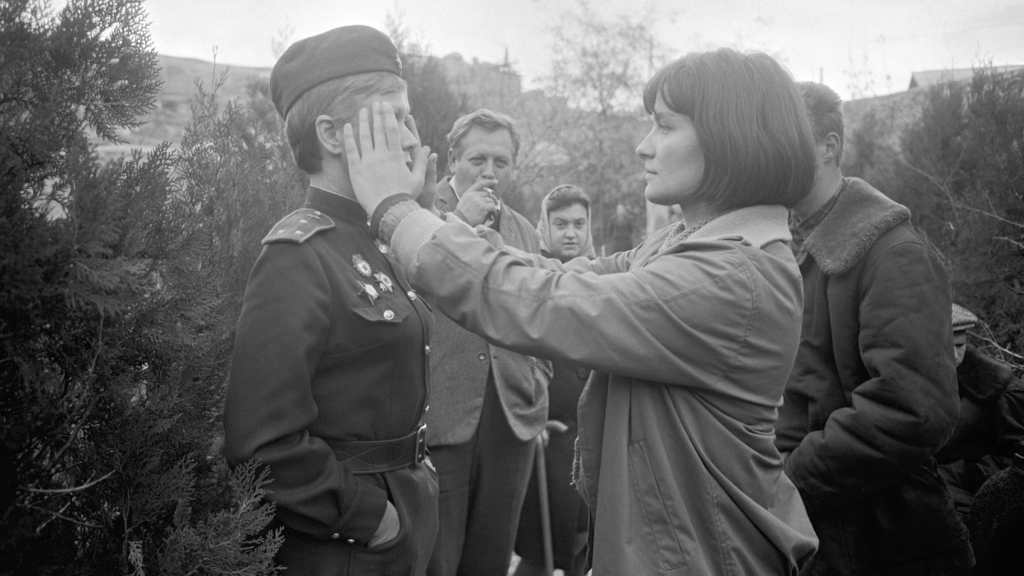
Celluloid Union is an ongoing exploration of Soviet filmmaking as a practice of worldbuilding through mass-culture. For the toiling peoples of Moscow’s 20th-century empire and its worldwide admirers alike, the dream of utopian socialism was never realized; always “just beyond” the horizon. Celluloid Union demonstrates the roles that the Soviet filmmaking apparatus played both in constructing that unrealized dream and in ensuring that audiences would not wake up from it.
Introduction: Deaths of an Auteur
Larisa Shepitko’s twenty-year directing career was a dance with death. It began with Shepitko directing her thesis film from a stretcher, riddled with jaundice and sweltering in the 50° heat of the Kazakh steppe. It ended, with tragic suddenness, in the passenger’s seat of location-scouting drive, 40 km from Moscow.
Shepitko’s accidental death shook the Soviet film world. “A car crash”–wrote a despondent Andrei Tarkovsky–“All killed instantly. So suddenly, that not one of them had adrenaline in the blood. It seems that the driver fell asleep at the wheel.” Larisa Shepitko’s death, as well as that of her fellow passengers, was tragic and premature. It also shattered the heart of her life/creative partner Elem Klimov, whose haunted and haunting close-up shots practically serve as iconostases of the late Soviet era.

Figure 1: A still from Farewell which seems a prototype for Klimov’s famous closeups in Come and See [1985].
There is nothing romantic about death, even the death of an artist pursuing their craft, “dying doing what they loved”. That said, I would be remiss to not begin this comparative study of the first and last works of Larisa Shepitko’s oeuvre with a nod to the unusually mortal encounters that bookend her work.
Further, Shepitko has, to some extent, suffered a kind of second death—a systemic exclusion from historical and cultural discourse. Her films have, until very recently, been overlooked in academic and popular film circles alike. Anastasia Sorokina attributes the discursive “disappearance” of Larisa Shepitko to both Soviet-era efforts by the cultural administration to bury her at times ideology-challenging work and contemporary over-emphasis in Euro-American academia on the pre-Stalinist “revolutionary filmmakers”. Quotidian sexism is, no doubt, also to blame.
This article is not a scholarly attempt to “rediscover” Larisa Shepitko. As I said, her films have been overlooked until recently—the interested reader can now find a number of compelling and meticulous works on Shepitko which are rapidly correcting for our collective ignorance of her contributions to global film culture.1 What this article is instead is an exploration of a common thread, a little irony which I feel connects her first and last films: the imperial condition of Soviet Cinema.
I do not explore the arc of Shepitko’s career, simply the origin and endpoint. This means that there is much in her personal artistic and philosophical evolutions which are not properly accounted for here. I do seek to portray Shepitko as some kind of Soviet ideologue (and she was, in fact, quite often in conflict with the Soviet cultural apparatus) but, instead, seek to demonstrate the fact that participation in an essentially imperial culturemaking apparatus results necessarily in a work of imperial cinema. That an auteur as brilliant and as critical of the Soviet system as Shepitko produced such cinema is a testament to the omnipresence of the imperial stink within Soviet (Russian) society.
Viewing the Films
Before we dive into that though, I will briefly introduce the films in the following two sections. These are not full synopses and I recommend you watch the films before proceeding, but these introductions give enough context for the final Comparative Analysis. Luckily for the Soviet-film-enjoyer, many of the companies which the republic film studios became after 1991 have few scruples when it comes to the copying and distribution of media. Both Kyrgyzfilm and Mosfilm maintain active YouTube channels where Heat and Farewell can be viewed for free. (Farewell is is in two parts.)
The Ukrainian “Mother of Kyrgyz Cinema”
In 1963, at the age of 25, the Donetsk-born and Lviv-raised Larisa Shepitko released her first film, Heat [1963], which was filmed under the blazing sun of the Kazakh steppe. Heat was Shepitko’s thesis film, a capstone project and the culmination of her studies at the most prestigious Soviet film school, Moscow’s Gerasimov Institute of Cinematography (VGIK). The film is a novel adaptation of The Camel’s Eye by the Kyrgyz author Chingiz Aitmatov. Film adaptation was a common practice in the Soviet Union. This is in part due to the fact that directors enjoyed greater “safety” while working with materia that had already passed the Soviet censors. Why risk your career on a script invented whole-cloth when you can use a preexisting “ideologically correct” short story or novel as your source material?
As we can see, this film was something of a “multinational” effort from the beginning—a work shaped by, at a minimum, artists and environments of Ukraine, Kyrgyzstan, Kazakhstan, and Russia. Heat was among the first films to be released under the auspices of the Kyrgyz SSR’s state film studio, Kyrgyzfilm, which, apocryphally, earned the Ukrainian Shepitko the title “The Mother of Kyrgyz Cinema”.2

Figure 2: The final shot of Heat. In this scene, the Stalin-esque Abakir walks off into the distance, leaving Kemel and the people of the kolkhoz to figure out how they will move forward without his stern leadership.
The story of Heat takes place in the steppeland of Kazakhstan during the early years of Nikita Krushchev’s “Virgin Lands Campaign” (VLC), Osvoyeniye Tseliny. The VLC, which ran roughly 1953-1963 was a massive and ultimately disastrous geoengineering project that sought to transform Central Asian terra sterilis into a much-needed breadbasket of the Soviet Empire. It follows Kemel, a youthful and urbane Kyrgyz komsomol who, like the doomed narodniki3 of the century before, acts as a missionary of Soviet society to the not-yet-fully-converted peoples of the rural steppe. Kemel takes a job on a remote village’s collective farm (kolkhoz) and his plucky, modern (Soviet) sensibilities quickly run him afoul of the village headman Abakir. Abakir, who is seemingly both an unsubtle Stalin caricature and an emblem of “oriental despotism” routinely abuses Kemel and his other workers, working them hard but inefficiently—unjustified cruelty—which our Soviet hero cannot abide!
Heat enjoyed a relatively small release in the Soviet Union, but was awarded a number of prizes both in student film circuits and, notably, the Best Director Award at the 1964 All-Union Film Festival—a feat for a student film that speaks to Shepitko’s talent.
A Farewell to “Mother Russia”
In 1983, at what would have been the age of 45 had she lived to see it, Shepitko’s widower Elem Klimov completed the final film of Shepitko’s oeuvre: Farewell [1983]. Farewell would have been Shepitko’s seventh film in twenty years, making her one of the most productive filmmakers of her generation.

Figure 3: A still from Farewell that shows workers in plastic rain ponchos telling Matyora’s final holdout Darya that she must leave her home behind. (Selected for its vaguely Chornobylian visual quality.)
Compared to Heat, Farewell was shot much closer to home in the Tver region of the Russian Federated Soviet Socialist Republic (RSFSR).4 Farewell is also a film adaptation of a popular Soviet novel: the Siberian Valentin Rasputin’s Farewell to Matyora. Though she died before production of Farewell began in earnest, I consider it here to be Shepitko’s last work. Shepitko was the driving creative force behind the scriptwriting process and would have led the production had fate given her the opportunity to.
The film itself follows the plight of Matyora, a Siberian village-island which both figuratively and literally stands in the way of Soviet “progress” by obstructing a hydroelectric dam construction project. At the beginning of the film, Matyora’s people are told that the dam must be built and that, as a result, that their village must be destroyed. The film proceeds to show the deeply emotional process of removing the people of Matyora from their land, many of whom, you can imagine, are unwilling to leave until the last moment, as well as the coldly mechanical process of dismantling the village.
Despite being an adaptation, Farewell faced difficulties with the Soviet cultural authorities who assigned it a “limited distribution” upon release.5 Additionally, the authorities repeatedly denied the film an export license despite (or perhaps because of) the fact that it was chosen to open the 1984 Berlin Film Festival. Farewell was likely flagged due to its critique of unbridled Soviet modernization and its negative effects on the once-wild land of the Soviet interior. The film was finally released to a global audience in 1986, three years after its Soviet release and, coincidentally, the same year that Soviet mismanagement of the Chornobyl Nuclear Power Plant (CNPP) would displace more than 300,000 in Ukraine and Belarus.
Comparative Analysis
So, what do Shepitko’s Heat and “Shepitko’s” Farewell have in common? And what about that “little irony” I mentioned? What do I mean when invoke the “imperial condition” of Soviet cinema and how is it that these films, one of which was explicitly targeted by Soviet censors, fail to escape that condition?
For one, both films are adaptations. As I have attempted to demonstrate, this is not a superfluous fact. There is no doubt in my mind that Shepitko enjoyed reworking both of these films’ source-material novels into scripts, but one can also see the practice of adaptation as a form of self-censorship that was so ubiquitous within the Soviet system that it appears invisible.6
Beyond this fact, both films feature a similar setting: rural villages in the remote Soviet interior. In Heat, it is a Kyrgyz village in the Kazakh steppe while in Farewell it is a quintessentially Russian village in Siberia. Notable, both of these villages are exclusively Russophonic, which strikes this observer as unlikely, as an imperialistic smoothing over of cultural specificity and ignorance of regional context. Heat in particular appears to be one of the many examples found throughout Soviet film history of presenting the breadth of the Soviet Union, one-sixth of the globe, as a monolingual, and thus monocultural, unit led from the Muscovite metropol.7
Heat takes this monolingualism to a farcical degree when Kemel befriends a nomadic horsewoman that saves him from the malaise brought about by his first days in the village. The horsewoman is easily read as a kind of totem, representing the primordial bounty of Central Asia waiting to be courted (and exploited) by the energizing force of Soviet society. This figure, who with her playful nature and joyous smile reminds Kemel of his mission, has no spoken lines. In Heat, like many Soviet films of its era, you speak Russian or you are silent.
The two villages of Heat and Farewell, separated by at least 3,000 km and two decades of Soviet policy, find themselves both in the midst of revolutionary industrial change. In Heat, these changes are thanks to the VLC, the transformation of Moscow’s colonial holdings into factory-farmland while in Farewell, it is the transformation of a small piece of “Russia” itself.8 Given the very different positions they occupy within the imperial hierarchy of the Soviet Union (in which Russia and the Russians were doctrinally conceived of as the “first among equals”), it should be unsurprising that these two villages are treated quite differently by their respective films. This is apparent even in the somewhat trivial fact that I am able to refer to Farewell’s village with a proper noun name—Matyora—while the ethnicized anywhere of Heat’s Kyrgyz village goes completely unnamed!

Figure 4: A still from Heat that shows Kemel and the unnamed horsewoman enjoying each other’s company.
In the case of Heat’s unnamed village, the viewer is presented with a world that is “halfway there” with regards to its agricultural modernization. Heat is not the square-one tractor-drama of the early Soviet film canon. When our hero Kemel arrives, he is impressed to see quality work already being done, and with the help of a well-functioning Soviet tractor. The problem instead lies in how the authoritarian headman Abakir manages this work, abusing his workers and committing acts of gendered violence against his partner Kalipa. Progress has come to the village (Kemel) and eventually triumphing over the old ways (Abakir), those who have been wronged by them will be saved.
This is the exact opposite of the narrative arc presented by Farewell. Matyora is constructed as a kind of eden, a crucible and a nature preserve for the oft touted “Russian Soul” (russkaya dusha) imperilled by Soviet progress.
What does this difference suggest? Is it that Sheptiko’s views on the revolutionizing potential of Soviet industry have changed? Had twenty years taught her the harm that Soviet society wrought upon the land? Or had the bounds of acceptable discourse within the imperial culturemaking apparatus moved such that this new view of the precarity of the land could now be expressed?
Empire Cinema
So, why does Shepitko’s first film position Soviet progress as a just force while her final film positions it as a destructive one?
Is the end result of a twenty-year intellectual journey? Afterall, an older Shepitko would playfully denounce the film as “merely exercise that had to be done within the walls of VGIK”. Perhaps Farewell represents the worldview of a matured Shepitko reflecting on the ecological and cultural harm ultimately caused by misadventures like the VLC. We might call this the auteurist read, as it is interested in how Shepitko expressed her thoughts through these two films. Given the limited scope of this article and the fact that Shepitko ultimately was unable to lead the production of Farewell, this is not a defensible position to take.

Figure 5: A still from Heat which shows Soviet workers attempting to draw groundwater to the surface of the Kazakh steppe by repeatedly driving back and forth in large, empty dumprucks.
Alternatively, perhaps the shift has more to do with precisely “the walls of VGIK” that Shepitko references, i.e. the prescriptions and restrictions of the official Soviet culturemaking apparatus. Perhaps we must understand Heat as an interesting but ultimately uncontroversial exercise, one which served the purpose of its moment (promoting and justifying the VLC’s radical transformation of the Central Asian biosphere) and, in doing so, allowed Shepitko to be stamped with the Soviet state’s approval.
In this read, an institutional read, Shepitko is a propagandist who, over the course of a career, becomes secure enough in her position to begin critiquing the Soviet progress myth with her films (this trajectory is of course not uncommon among the Soviet directors). This position seems more defensible, though again due to scope, this article lacks the kind of rigorous exploration of the mid century Soviet culturemaking apparatus that a truly academic work would require. So, allow me to posit a third position, an imperial read.
Let us, for a moment, be purposefully blind to the persona of Shepitko and ignorant of any individual philosophical journeys she may have embarked on. Let us also condense all the nuances, intricacies, and conflicting goals, stated or otherwise, of the state-run Soviet film industry into a simple statement: Soviet cinema existed to reproduce Russia’s empire.
At its core, this statement is little more than a reframing of Lenin’s famous declaration that “The cinema is for us the most important of the arts”. The “importance” of cinema for Lenin came from its worldmaking power. Cinema was augury for the revolutionary generation, imagining the Communist utopia of tomorrow today, a kinetic blueprint that could, via the magic of celluloid, be spread to the furthest corners of the fractured and feudal Russian-turned-Soviet Empire.9
In this articulation, Heat fits relatively comfortably.10 Kemel, a ridealongs with both the ancient, nomadic spirit of his people and some truck-driving naronik-lads (whose oafish ilk would go on to drain the Aral Sea), he is compelled as an eidolon of socialist realism to topple Abakir’s regime. Kemel publicly stands up to Abakir, resulting in the former’s humiliation and flight; Soviet progress contests lumpen parochial cruelty, leaving room for a new, Soviet order.

Figure 6: A comparison of the Aral Sea in 1989 and in 2014 (photo NASAA, original is in color). The disappearance of the Aral Sea represents one of the most visible consequences of Soviet geoengineering in Central Asia.11
Farewell, on the other hand, does not fit as neatly within this mold. Rather than presenting a backward village in need of transformation by Soviet society, we see a beloved village in danger of disappearing thanks to Soviet society in what amounts to critique of that society. A critique of Soviet progress? A warning to pump the brakes on its destiny manifest? How could such a thing be allowed? Well, what if you couch your critique of the Soviet Empire in a way that nostalgically invokes the glory and mysteries of the Russians as a people? Ah ha!
As I hinted at earlier in this article, the village plays a special role in the Russian psyche. It is a secret world, carried in the heart. It is an untouched place where Jesus Christ and a domovoy can live comfortably under the same, wooden roof. It is an escape from the hustlebustle of urban living and thus, in society whose ultimate goal was the transformation of human society into a proletarian Elysium, a safety-valve for breakneck Soviet modernization. In Farewell, this safety valve is shown as at risk of slamming shut, thus risking the integrity of the system as a whole.

Figure 7: A still from Farewell which depicts a teary departure from the island-village of Matyora.
Much academic ink has been spilled on the topic of nostal’giya in late-Soviet film and especially post-Soviet Russian film,12 and many who have written about Farewell have contributed to this spillage. It is easy to understand why. Imagine a Soviet-era theater, somewhere in Moscow or Petersburg, full to the brim and about to screen Farewell. How many in that crowd have a Matyora of their own? Perhaps they were born in a Matyora, or their mother was, or their grandmothers. Perhaps they spent their childhood summers exploring the dense woods of their own private Matyora, had their first kiss up against a birch there, etc. The film visualizes home and asks its audience to consider how progress might, afterall, have a price ceiling. But how was that price determined again?
Herein lies the great difference between these two films: while the Kyrgyz village must be remade, Matyora must be protected. “Sovietization for thee, not for me”, a sentiment emblematic of Russia and the Russians as “first among equals” in the Soviet Empire.
Conclusions
Heat and Farewell are, as demonstrated here, have similar settings but, by virtue of the time period in which they were made and, crucially, the socio-ethnic context of their characters, are very dissimilar stories. In the first, didactic, the Kyrgyz village is remade by the revolutionary force of the New Soviet Man. In the latter, therapeutic, the Russian village, and with it the “mysterious Russian soul” it cultivates, is at risk of annihilation by Soviet progress.
I see this difference as significant because it demonstrates a fundamentally different understanding of Russian rurality versus non-Russian rurality—the first as a mystical authenticity and the latter as a teleological backwardness—which is reflective of the lingering chauvinist nature of Moscow’s Empire in its Soviet iteration.
Even Larisa Shepitko, who was by no means a Soviet hardliner, who came from an ethnically mixed background, and who was often subject to censorship by the soviet cultural apparatus could not escape reproducing this imperialistic cultural hierarchy in her work. If anything, the fact that she may have “changed her mind” about the nature and efficacy of the Soviet system in the latter years of her career, and yet decided to tell this story in a Russian context results in two distressing implications.
One, it posits a kind of “test subject” status for the colonized peoples and territories of the Soviet Union: “We tried Sovietism in Central Asia and look what happened! We can’t let that happen to our Mother Russia!”. Two, it suggests that even on the cusp of Glasnost, the Soviet cultural establishment was not ready to discuss the harm its empire had caused to the cultures and biospheres it colonized: “This is a story worth telling, but you can only tell it in a language the Russians will understand: nostalgia.”
References
- Erley, Mieka. On Russian Soil: Myth and Materiality. Cornell University Press, 2021.
- Климов, Элем. Лариса: Книга о Ларисе Шепитько (Larisa: A Book on Larisa Shepitko), 1987.
- Ковалов, Олег. Лариса Шепитько (Larisa Shepitko). сеанс, 2022.
- Mandušić, Zdenko. “Methods of Conquest: Larisa Shepitko’s Heat, Soviet Russian Colonialism, and the Representation of the Virgin Lands Campaign in Soviet Cinema of the 1950s–60s.” In Refocus: The Films of Larisa Shepitko, 2024.
- Michael Wines. “Grand Soviet Scheme for Sharing Water in Central Asia Is Foundering”. The New York Times, 2002.
- Sorokina, Anastasia. “The Lady Vanishes: Soviet Censorship, Socialist Realism, and the Disappearance of Larisa Shepitko.” Film Matters 8, no. 3 (December 1, 2017): 21–27.
- Widdis, Emma. Visions of a New Land: Soviet Film from the Revolution to the Second World War. Yale University Press, 2003.
Notes
- For example, in 2024, Edinburgh University Press released a collection of twelve (in my opinion) magnificent essays on Shepitko as an edited collection titled ReFocus: The Films of Larisa Shepitko (Edited by Lida Oukaderova). ↩︎
- It should be noted that Heat, however, was not the first film to be produced at Kyrgyzfilm. This honor more likely belongs to the film Saltanat [1956], another VGIK thesis film by Lilya Turusbekova. In a 2003 interview with the Russian magazine Gazeta Truda, Shepitko’s famous husband Elem Klimov misattributes the title of “first Kyrgyz film” to Heat, which came seven years after Saltanat. This very public misattribution is a potential source of confusion. ↩︎
- The narodniki were a group of 19th-century intellectuals across the Russian Empire who sought to make Agrarian-Socialist revolutionaries of the Empire’s massive, and largely “apolitical” rural population. Those interested in learning more should check out Mike Duncan’s Russian Revolution season of the Revolutions podcast. Episodes 10.20 and 10.22 specifically introduce the Narodism, along with the plethora of other revolutionary ideologies bubbling around in the Tsarist era. ↩︎
- “RSFSR” is the name for the “Russian” portion of the USSR. It was roughly coincident with the modern Russian Federation (RF) and was made up of a number of constituient, federated, Soviet Socialist Republics. Many of these federated republics were not, strictly speaking, “Russian”, but were instead the home of a number of Asian, Turkic, and Caucasian peoples; just as today’s Russian Federation is composed of a number of non-Russian republics. ↩︎
- In the Soviet film distribution system, films were assigned different release categories that determined where in the empire they were shown, for how long, what kind of theaters they were to be shown in, etc. The “Limited Release” (ogranichennyy vypusk) designation given to Farewell meant that it was only to be shown in the RSFSR and only at a small number of in so-called “art cinemas” rather than at screens for the wider public. Many ideology-challenging films met this fate, a kind of cinematic quarantine. ↩︎
- This is not to say that all adaptation is self-censorship. Nor is it to suggest that self-censoring adaptation is unique to planned economies or authoritarian polities either—adaptation was considered “safe” in Soviet society because it meant working with materia that have already approved by state censors, similar to how contemporary, financialized cinema traffics in adaptations (and “reboots”) of materia (or IPs) that have already been been approved by that most hydralike of all censors: The Market. ↩︎
- This is not to say that the peoples of the Kyrgyz SSR did not speak Russian. Many did, as do many in the Kyrgyz Republic of today. That said, knowledge and use of the Russian language across the Soviet Union was always most prevalent in urban contexts. Given the strictly rural setting of Heat, a more “accurate” depiction might have had Kemel, as the urban-schooled komsomol, code-switching between Kyrgyz language with the villagers and Russian language with the (white) Russians that he meets later in the film. ↩︎
- Farewell can be seen as a semi-playful inversion of the traditional Soviet “electrification” narrative, in which typically the socialist hero returns home to their village with new techniques and technologies that revolutionize (for the better) village life. In Farewell, a “electrification” in the form of the new hydroelectric dam instead Shepitko prototyped this inversion in her film Homeland of Electricity [1967], which was shelved for twenty years after it was completed due to its critique of the heavy-handed methods of the Bolsheviks. ↩︎
- It is a reframing made with the benefit of hindsight—certainly Vladimir Ilyich would have scoffed at my conflation of “Soviet” and “Russian”, but, as reality would have it, any fight against Great Russian chauvinism in Soviet Union died with him in Gorki. ↩︎
- The ending of the film rings with a bit more uncertainty than a Soviet film of an earlier generation, but then again you really can’t expect people to swallow the sycophantic delusionalism of films like The Cossacks of the Kuban [1950] for any more than a couple decades. Look at the film industry of the DPRK. ↩︎
- Soviet hydrologist Aleksandr Asarin is quoted as saying that “[The Aral Sea project] was part of the five-year plans, approved by the council of ministers and the Politburo. Nobody on a lower level would dare to say a word contradicting those plans, even if it was the fate of the Aral Sea.” (Wines 2002) If the Soviets were unaware of the ecological harm the VLC could cause, perhaps it was because of the anti-intellectual culture of fear they cultivated. ↩︎
- For the interested, I recommend Nancy Condee’s book The Imperial Trace: Recent Russian Cinema, which isn’t so recent as it was when she released the book in 2009, but does provide an extremely compelling overview of late 90’s and aughts cinema in Russian. It catalogues well the “imperial hangover” experienced by a then rapidly-contracting Russian society and provides keen insight into the cultural forces at work in Muscovy to this day. ↩︎
 The Old World Review
Leave a comment