
This is a guest article written by Jake Todd. Pictures added by M.A.
The Gagauz of Moldova are one of Eastern Europe’s many forgotten minorities (although they themselves would most likely object to that term). Concentrated in an autonomous community of the southern Budjak region of modern Moldova known as Gagauzia, the roughly 150,000 Gagauz are a Turkic people who claim that their presence in the region dates to the Middle-Ages and the migrations of fellow Turkic peoples such as the Bulgars, Pechenegs and the Cumans.
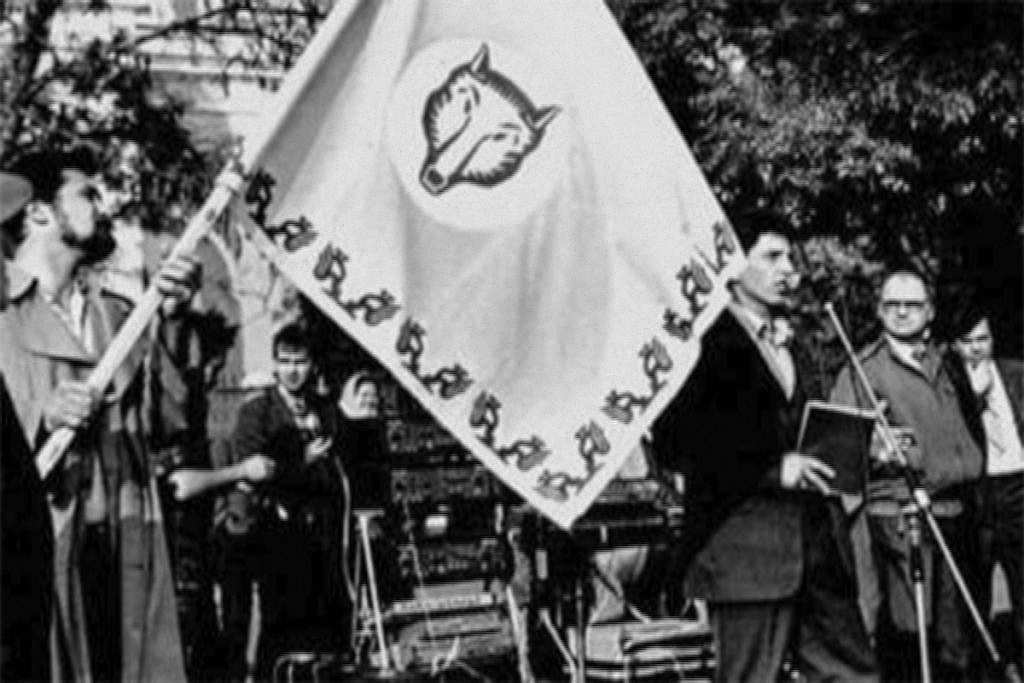
These origins are disputed, however, and others (mostly Moldovans) have suggested that the ‘real’ origins of the community lie with Russian resettlement policies following their acquisition of the territory during the 1877-1878 Russo-Turkish War. The Gagauz are unusual amongst modern Turks in that, like most of their neighbours, they are largely practitioners of Eastern Orthodox Christianity rather than Islam. However, they also continue to maintain their own language- Gagauz- a Oghuz Turkish language closely related to modern Turkish, Azerbaijani and Crimean Tartar, and a sense of Turkishness, demonstrated most obviously from the continuing popularity of the Bozkurt Wolf (a common Turkist symbol), remains prominent within in the community.

These heterogeneous characteristics (by the narrow standards of traditional nationalism) in a region which is itself populated by a wide variety of peoples (including Romanians, Bulgarians, Ukrainians and Russians amongst others) has ensured that Gagauz identity is difficult to grasp even today. It is believed that, as Orthodox Christians, the Gagauz were identified simply as Rûmi under Ottoman rule, but as the divisive influence of 19th Century nationalism began to be felt in the region, the Russian authorities increasingly identified the resettled community as Turkish-speaking Bulgarians (conveniently in this period of Russian pan-Slavist activism). Unsurprisingly, the modern Gagauz largely reject both of these ideas, insisting that they are simply Gagauz, and that the uprisings of the early 20th Century were not merely social uprisings as Russian and Moldovan sources suggest, but rather the work of an early ethno-nationalist independence movement.
Such nation-building initiatives have not been received well in Moldova and the Gagauz maintain an often-uneasy relationship with Chisinau. Much like the far more famous breakaway region of Transnistria, the prospect of further Romanianisation and unification with Romania continues to be a major worry in Gagauz communities, and following growing tensions with the Moldovans amidst the collapse of the USSR and the breakaway of an independent Moldova in the 1990s, the Gagauz took up arms against the burgeoning state. Low level fighting ensued before a settlement was reached in 1994 which granted Gagauzia autonomy within Moldova, as well as the right to self-determination if Moldova’s constitutional status ever changes (i.e. in the event of unification with Romania).
Despite these moves towards reconciliation however, today, Gagauzia remains amongst the poorest and least developed regions in Moldova, with nostalgia for the USSR and pro-Russian feeling remaining pervasive in Gagauz communities.[1] It is estimated that almost half of Gagauz households speak Russian at home rather than Gagauz, and Russian remains overwhelmingly dominant in Gagauz education and administration. In the wake of Russia’s aggressive support for Russian-speaking separatist movements in Ukraine then, it would be a mistake for Moldova and wider Europe to continue to neglect the Gagauz as a possible flashpoint for future tensions, especially in comparison to the attention given to Transnistria, a pro-Russian community with a similar strategic position on Ukraine’s western border.
It is possible that this relative neglect stems from the Gagauz’s Turkic character, as despite their Orthodox faith and heavy pro-Russian leanings, there remains a tendency to link the Gagauz’s positive reception to recent Turkish overtures to Turkey’s so-called neo-Ottoman foreign policy. This ambitious policy has seen growing Turkish tensions with both the “West” as well as Russia, and its growing economic and diplomatic investment in Gagauzia has been identified by some as an attempt by Turkey to undermine Russian influence in this vital strategic area.[2]
Regardless of what Russia, Turkey or Moldova have planned for Gagauzia however, what is clear is that despite their struggles to the contrary, self-determination remains an empty ideal for the Gagauz. Much like their status in the 19th Century struggles between Tsarist Russia, Ottoman Turkey and the new state of Romania, the Gagauz seem fated to exist as a pawn in the struggles between their larger neighbours for the foreseeable future.
Certainly, if Moldova ever does reunite with Romania, the independent Gagauzia would be wholly dependent on Russian support, a state which Romania, a NATO and EU member state, would almost definitely find to be an intolerable security risk. The idea of an independent Gagauzia remains somewhat of a pipedream then, but perhaps the unique character of the Gagauz people can be preserved for future generations, as it is certainly in the vested interests of both Russia and Turkey to support Gagauzia’s autonomy at the expense of Moldovan unity.
[1] A recent referendum demonstrated that as many as 98% of Gagauz favoured a closer relationship with the Russian-backed ECU than the EU.
[2] Turkey remains the only state to maintain a consulate in Gagauzia’s capital of Comrat.
On the cover: Establishment of the Gagauz Republic declared in Komrat on the 19th August, 1990. Photo from discovergagauzia.md
 The Old World Review
Leave a comment