

Romanian philosopher Emil Cioran (1911-1995), known for relatively pessimistic works of philosophy and lyrical aphorisms, spent decades pondering mortality and existence. Decay and futility, of both the individual and society, were prominent themes in Cioran’s literature. Simultaneously, his works reflected not only his own migrant’s struggle for identity and ‘metaphysical exile,’ but also his contemplation on the woes of personal madness and societal obsessions.
There is something amusing in an image of a gloomy thinker – a man who continues to inspire a strain of angst in certain subcultures – finally facing the old being way may characterize as time, after spending almost a lifetime judging its creations. The sense of anxiety and irrationality so prevalent in his books seem to carry the heavy legacy of European modernism and its pessimism. If we were to, for instance, add one of the most famous Roman philosophers and politicians from 2000 years before, one with a certain stoic inclination, standing humbly next to him – how would this contrast look? Which one would be keener to welcome the judgment of Father Time? And more broadly, we may touch upon the question of what has brought cynicism to such strains of 20th century existentialist writing.
It may seem like a silly comparison, and it may be one indeed. From an academic perspective there is little commonality between a mid-20th century existentialist dabbling in occasionally mystical themes (“Trăirism”) and a Roman orator whose works existed in a completely different plane of history. Yet, if not the universality of the theme at hand, it is Cioran’s ironic character that warrants thought experiments such as this one. For he was a man with many oddities to his personality and life. A man who enthusiastically moved to Paris to write a thesis that was never to see the light of day, merely using this endeavour for student benefits and discounted meals. A man whose life abroad was financially supported by a far-right regime, only for him to escape the very nation that bestowed this patriotic position upon him. A man who could not even write his personal journals without adopting the voice of his absurdly melancholic works of philosophical study.
Cioran considered himself as a subject to a “metaphysical exile,” a condition mostly sentimental in nature, but which can be understood at least in two ways. On one hand, he saw himself – along with his friend Mircea Eliade – as “have-been believers; […] religious minds without religion.” In this way, the concept refers to an internal whole devoid of spirituality or other meaning to justify his experience of existence. On the other hand, Cioran sought to distance himself from his fatherland Romania and “Romanianess” which he saw as a nullified, hollow identity of a nation so far unable to establish itself. This pursuit led him to a self-imposed exile in France, where he finally abandoned his native language altogether for French.
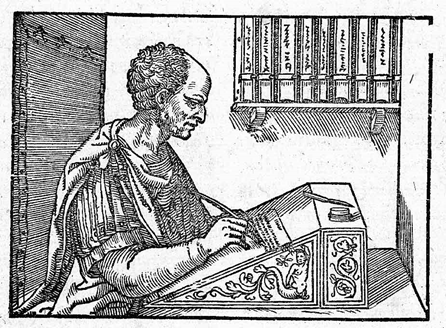
It is remarkable, and quite ironic, how far Cioran’s own obsession about futility and meaning would take him in his own life as a philosopher. Mortal vanity embedded in obsession and madness, so very deeply rooted in human condition, would provide almost endless lyrical philosophizing for both young and older Cioran. According to him, we live because the “desire to die is too logical, hence ineffective.” Human existence rests on illogical, irrational nothingness. Time too, is on a course we don’t share, but merely witness as “prisoners of a stupid perception.”
Cicero’s thinking is somewhat typical for Roman stoicism, that has recently gained popularity and acknowledgment. Whether a fatalistic tool for the ruling class or – as it is now presented for young men – a self-devoted philosophy for a personal peace of mind, stoicism was not detached from the Roman virtue ethics or worldview marked with filial piety and respect for ancestral lineage. History writing served a need for us to learn from those before us, a trait certainly not particular to that of Western thinking. In China, philosophical lessons in Confucian or Legalist thinking, for instance, were exemplified with the successes and failures of ancient rulers. History and time in ancient societies created a continuum that was understandable; from which one could learn from and, as Mircea Eliade (philosopher of religion and Cioran’s old friend) argued – one could participate in and even live through ritualist traditions.
Yet what happened at the end of the “long 19th century” was unforeseeable for many, breaking grand narratives that European intellectualism had shaped, whether in the form of Enlightenment or otherwise. Positivism, technocracy, progressivism and rationality in general faced a crisis of maddening annihilation of the European continent and later, of the world as a whole. George Steiner was by no means the only one to stress the civilizational trauma caused by the events of 1914, but was accurate in his take. “We have not begun to gauge the damage to man—as a species, as one entitling himself sapiens— inflicted by events since 1914,” Steiner wrote, “we do not begin to grasp the co-existence in time and in space, a co-existence sharpened by the immediacy of graphic and verbal presentation in the global mass media, of Western superfluity […]”. While it seems popular to label certain authors “nihilist” or pessimist, Cioran’s writings in 1930s and 1950s were certainly more than merely personally conceived angst, directly resonating with the sentiments of a struggling nation in a world continuously erased since 1914.
Most importantly, the post-1914 – or perhaps even more aptly post-1944 – feelings of aimlessness, whether in national history or everyday society, trickled down deep into human existence in Cioran’s work. Our personal perceptions of linearity of time, or memory, also inhabit similar realm of irrationality as history. Cioran does not see memory as something to give comfort in the form of recollection of past pleasantries. Instead, it is forgetfulness that allows us to carry on, for whoever would remember the “totality of past pains” would break down under their weight. This is in somewhat of a stark contrast with the old Roman’s appreciation of life-long wisdom gathered over the years, with the culmination of ancestral knowledge. Yet in a world where progress has been failed by (as Steiner put it) “the distinct possibility of reversal of evolution,” it is imperative for us to forget rather than recollect the challenges and struggles of the past, former being a task in which one’s composure could face immediate collapse.
While Cioran was certainly influenced by previous existentialists and many other facets of Western philosophy before him, the lamentation about the fragile conditions of human life had been discussed for many generations before. Cicero notes the tendency already amidst educated people of his time to discuss (or “complain”) the futility of life, yet restraints himself from it: “I don’t want to complain life, as many educated men have often done, and I do not regret that I have lived, for I have lived in a way that I don’t see myself having been born for nothing.”
Cicero makes it clear that life does not rest on mere nothingness, and thus it carries no regret nor reasons to complain over it. In his fictional dialog between Scipio and Cato, he attributes a line to the latter that could concern Cioran as well: “[…] seemingly you admire something that is not hard at all. For those who have no strength of their own for a good and happy life, every age is difficult.” Happiness is clearly easy, implies the dialog – “I’m wise in the sense that I follow and obey nature, the best guide, like a god.” According to Cicero, the best instruments for the old age are sciences and, as appropriate for the ancient Roman school of thought, cultivation of virtues. Cioran on the other hand, admits to have been a believer without faith, whether towards gods or nature. In his writings, irrationality and obsession rule over the Earth. In contrast, Cicero embraced his “delusions” for their practical value: “And if I am wrong to believe human soul as immortal, I’m gladly wrong, and as long as I live, I won’t allow myself to be stripped from this delusion that brings me joy.”
However, it is unlikely that a self-proclaimed religious mind may live without religion. Likewise, its dealings tend to come with hope, even if only to pave way for reason and rationale. Even disregarding his intellectual work, Cioran, in a lifelong run away from Romania and his roots, clearly allowed himself some hope for a life as someone else, somewhere else. And, to again cite Steiner, what meaning can abstractions such as “hope” have in a wholly irrational world?
The many ironic facets of Cioran’s life and character were most likely not lost on himself either. In her critical biography of his old friend, Zarifopol-Johnston argues that distance characterizes exile and irony. In the former, “from the infinite distance of old age and different geographical and cultural space the wise but decrepit old Cioran ironizes the ambitious but foolish young” Cioran. It is in such solemn reflection where lyricism loses a part of its actualizing magic, where distance finally tears down the “illusion of unity between the project of the self and the actual historical self.” This experience of metaphysical exile and self-reflection was to inject elements of irony into his later writings, where older Cioran both ridiculed and admired the idealism of his younger self. In somewhat of a paradox, it only seemed to deepen the depths of the philosopher’s metaphysical exile.
Yet, perhaps it was the same distance in time and irony that also ultimately made Cicero’s account of aging relatively grounded. Reflecting on the the gap between his younger and older character allowed for not only self-reflection but also certain tranquillity. To this end, despite the historical burdens and tones, the contrast between Cioran’s and Cicero’s conceptions of time and being, and of getting old, may not have been so strong. Perhaps Cicero has a point in his delightfully simple conclusion: “Being old is the last act for life, as if it was a play; we have to look that we don’t get bored of it, especially if we have already had enough of it.”
Due to the clunky formatting with WordPress, instead of a proper footnoting I have only put a very concise bibliography below. For more in-depth sourcing you can comment on the article or contact me directly.
Citations are from the following pages:
- Cioran, E. M. “Beginnings of a Friendship,” in Myths and Symbols: Studies in Honor of Mircea Eliade. Edited by Joseph M. Kitagawa and Charles H. Long. Chicago: The University of Chicago Press, 1969: 414.
- Cioran, E. M. A Short History of Decay. Translated by Richard Howard. London: Penguin Books, 2010: 11-28.
- Cicero. Vanhuudesta, Ystävyydestä, Velvollisuuksista. Translated by Marja Itkonen-Kaila. WSOY, 1992: Helsinki: 43[84] – 44 [85].
- Steiner, George. Grammars of Creation (Gifford Lectures, 1990). Open Road Media, 2013: New York: 9 – 11.
- Zarifopol-Johnston, Ilinca. Searching for Cioran. Edited by Kenneth R. Johnston. Indianapolis: Indiana University Press, 2009: 147.
 The Old World Review
Leave a comment